


Padel · Rules of the game
Padel Rules, Explained Simply
The serve, scoring, the walls, par 3 and par 4: everything you need before your first match. All that's missing is the other three players.
Scan to get the appPoint your phone's camera at it.

Padel court size and dimensions
The court is a rectangle with no tramlines, split by a net and enclosed at the back and sides by glass walls and fencing.
| Element | Measurement |
|---|---|
| Playing area | 20 m long, 10 m wide |
| Net | 0.88 m at the centre, up to 0.92 m at the ends |
| Service lines | 6.95 m from the net, parallel to it |
| Centre line | 5 m from each side, running 20 cm past the service lines |
| Back wall | 4 m high: 3 m of glass and 1 m of fencing |
| Clear height | at least 7 m above the court |
| Ball | 6.35 to 6.77 cm across, 56 to 59.4 g |
| Racket | at most 45.5 cm long, 26 cm wide and 38 mm thick, with a wrist strap |
The serve in padel
- The server gets two serves, as in tennis.
- Stand behind the service line, between the centre line and the side glass, without touching the lines. Keep at least one foot on the ground; no walking, running or jumping.
- Bounce the ball behind the service line, then hit it underhand, at or below waist height.
- The ball crosses diagonally and bounces in the opposite service box, lines included. The first point of each game is served from the right, then sides alternate.
- After that bounce the ball may hit the glass, but not the fence: that is a fault.
- A serve that clips the net and lands in the right box is a let and is replayed, unless it then hits the fence directly: fault.
- The receiver may not volley the serve: let it bounce.
Scoring
- As in tennis: 15, 30, 40, game.
- At 40–40, depending on the competition, you play advantage (two clear points) or a deciding point: the receiving pair chooses the side it is served to, and whoever wins it wins the game.
- A set is usually won at 6 games with a two-game lead, with a 7-point tie-break in some formats.
- A match is usually best of three sets. Some formats replace the third set with a 10-point super tie-break.
- Change ends when the total number of games in the set is odd, and every 6 points during a tie-break.
Playing off the glass and the fence
- The ball may bounce only once on the ground on the opponents' side.
- After that bounce it can hit any surface: glass, fence, even the door handle are part of the court.
- Once over the net, a ball that hits the opponents' glass or fence before the ground is out.
- You can return the ball by hitting it against the glass on your side, never against the fence on your side.
- A ball that lands in the corner touching the ground and the glass at the same time is good.
Par 3 and par 4: when the ball leaves the court
If the referee allows playing outside the court, a player may leave the court to reach a ball before its second bounce.
- Par 3: the smash sends the ball out over a 3 m side fence. The point ends on its second bounce, or as soon as it hits anything outside the court.
- Par 4: the ball goes out over the 4 m back fence. The point is won the moment it clears the fence.
- A smash that bounces on the opponents' side and comes back to yours untouched is a winner. But if the player who smashed, or their partner, touches the ball before it bounces on their side, their pair loses the point.
When do you lose the point?
- The ball bounces twice on your side.
- You touch the net, its posts, or the opponents' court or fence while the ball is in play.
- You hit the ball on the opponents' side before it has crossed the net, or you jump over the net.
- Your shot hits the opponents' glass or fence directly, before the ground.
- You hit the ball twice, or it touches you or your partner before crossing the net.
- You throw your racket at the ball.
- The server misses the second serve.
Where these rules come from
The French federation's padel rules of play (FFT Statutes and Regulations 2023, edition of 1 September 2022) and, for the back wall height, the FFT court specification. In competition, the year's FFT padel competition guide sets the formats: deciding point, super tie-break.
Related guides
Frequently asked questions
Can you play padel with two players?
The official rules only cover doubles: two pairs, four players. Some clubs also have narrower courts for one-on-one play, outside the competition rules.
How do you serve in padel?
Underhand. Stand behind the service line, bounce the ball behind that line, then hit it at or below waist height. The ball must cross diagonally and bounce in the opposite service box. You get two serves.
What are par 3 and par 4 in padel?
Smashes that send the ball out of the court, when playing outside is allowed. Par 3: the ball leaves over the 3 m side fence; the point ends on its second bounce. Par 4: the ball leaves over the 4 m back fence; the point is won as soon as it clears the fence.
Can you touch the net in padel?
No. If a player, their racket or anything they carry touches the net or its posts during the rally, their pair loses the point.
Can you hit the ball against your own glass?
Yes: you can return the ball by hitting it against the glass on your side. Not against the fence on your side, and the ball must never hit the opponents' glass or fence before the ground.
How do I find three players for a match?
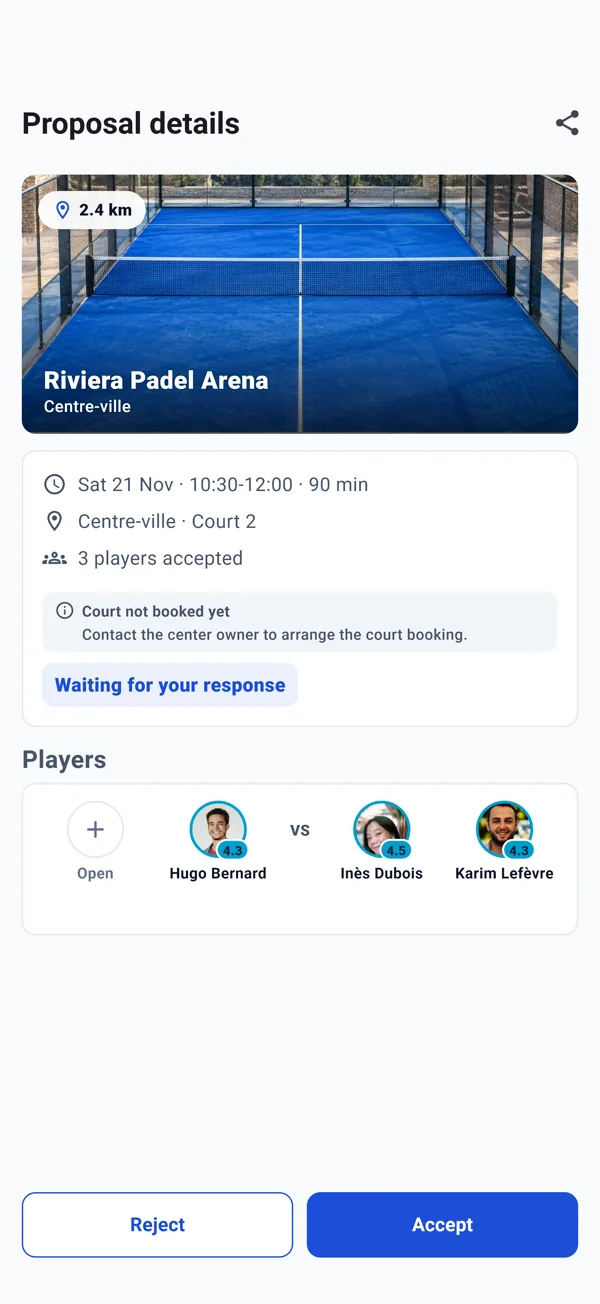
In CourtSync, say when you're free and your level. When players at your level are free at the same time near you, the app suggests a match. You accept and the match is created.
Find the other three without chasing anyone.
Share your free slots, join an open match or create your own. Free on iOS and Android. Optional Pro at €4.99/month adds court alerts and advanced stats.


Scan to get the appPoint your phone's camera at it.